
Lenin Peak: 7,134m in the Pamirs
A serious 7,000m expedition in the Pamirs that does not ask for a climbing CV.
From £4,995
£500 deposit to reserve, payment plans available

Eight days in far eastern Turkey to climb Mount Ararat, 5,137m, the highest point in the country: a dormant volcano that rises more than four thousand metres straight off the plain near Doğubayazıt.
It is a trek, not a technical climb, and no previous experience is needed. What it asks for is real fitness, four nights under canvas and an eighteen hour summit day with crampons on the ice cap.
Ninety minutes from Iğdır airport to a hotel in Doğubayazıt for a kit check and briefing. Next morning the trailhead at 2,200m, then about four hours through open grazing country to base camp at 3,200m, where the crew have the tents up.
A full acclimatisation day takes you to 4,200m and back down to sleep at base camp. The next day you move up for good, three to four hours over rocky ground, to high camp below the ice.
Out of high camp around one in the morning, five to seven hours up steep, often icy ground for sunrise on top, then down to base camp the same day. Next afternoon, a Turkish bath and a celebration barbecue.
Fit walkers happy with consecutive five or six hour hill days, who will train properly
No technical skill or previous experience needed, though crampons and an ice axe are used on the summit ice cap
Solo travellers are common on this trip and very welcome; tents are shared and the group is ten at most
Not for anyone who needs a shower and a bed every night: there are four nights camping with no facilities
Turkish entry rules vary by nationality, so check whether you need an e-visa against official guidance before you fly
Insurance must cover 5,137m and the use of crampons, which many policies exclude, so read the activity list
Routine vaccinations plus hepatitis A are commonly recommended; see a travel clinic well before departure
The climbing permit is issued in advance against passport details, so nobody can be added at short notice
This is a border region near Iran and Armenia, so carry your passport and expect road checkpoints
Hotel rooms are twin; a single room can be requested if available
If you want a genuine five thousand metre summit without needing to be a mountaineer, Ararat is a very good place to find it.
The expedition begins with the journey out. Flights are not included, so you book your own, and most guests travel from the UK via Istanbul on to Iğdır in the far east of the country.
It is a long day and worth treating as part of the trip rather than an inconvenience. Sleep if you can, drink water rather than the free wine, and try to arrive in reasonable shape, because tomorrow you are going to be looking at the mountain.
Your expedition leader will confirm the recommended flights and timings well before departure so that the group lands together, and we will meet you at Iğdır airport in the morning.
We meet you at Iğdır airport in the morning and drive south, around ninety minutes, to Doğubayazıt.
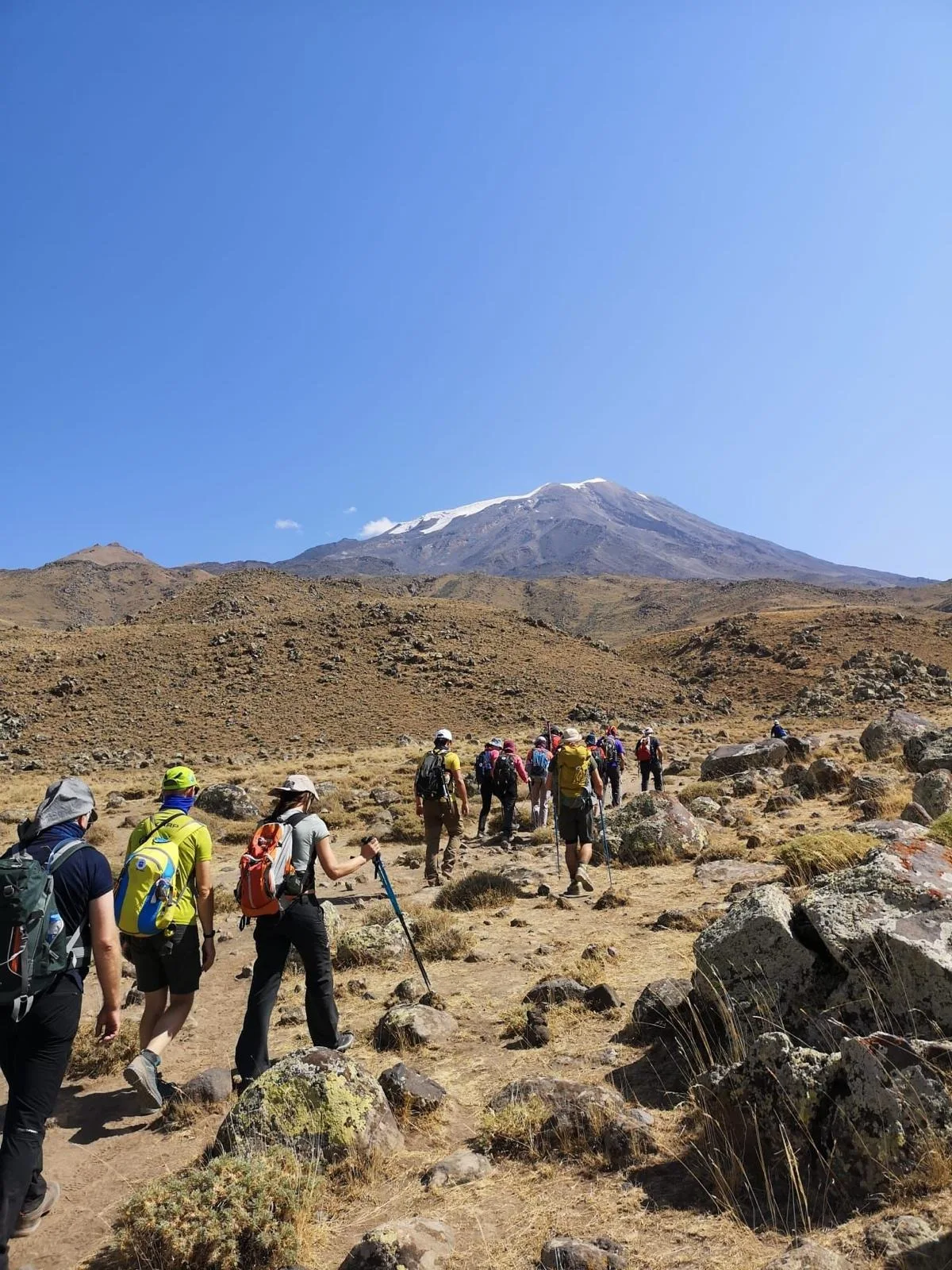
The drive is your introduction to the mountain. Ararat sits on the horizon almost the whole way, first as a pale shape and then as something increasingly hard to take seriously, a snow capped cone standing on its own above a flat brown plain.
Doğubayazıt is a working border town at around 1,600 metres, and our hotel is comfortable, with twin rooms and proper bathrooms. Today is deliberately easy: rest after the travel, eat well, and go through kit properly with the team before we head for the mountain tomorrow. If there is time and appetite, the İshak Pasha Palace on the hillside above town is worth an hour of anybody's day.
We drive out to the trailhead at around 2,200 metres, roughly an hour and a half from town, and start walking.
This first stage is genuinely lovely and much gentler than people expect. The trail climbs through wide open country scattered with wildflowers and grazing animals, with shepherds' camps here and there and the mountain rising steadily ahead of you the whole way. The pace is deliberately steady, both to let you enjoy it and because this is where acclimatisation begins.
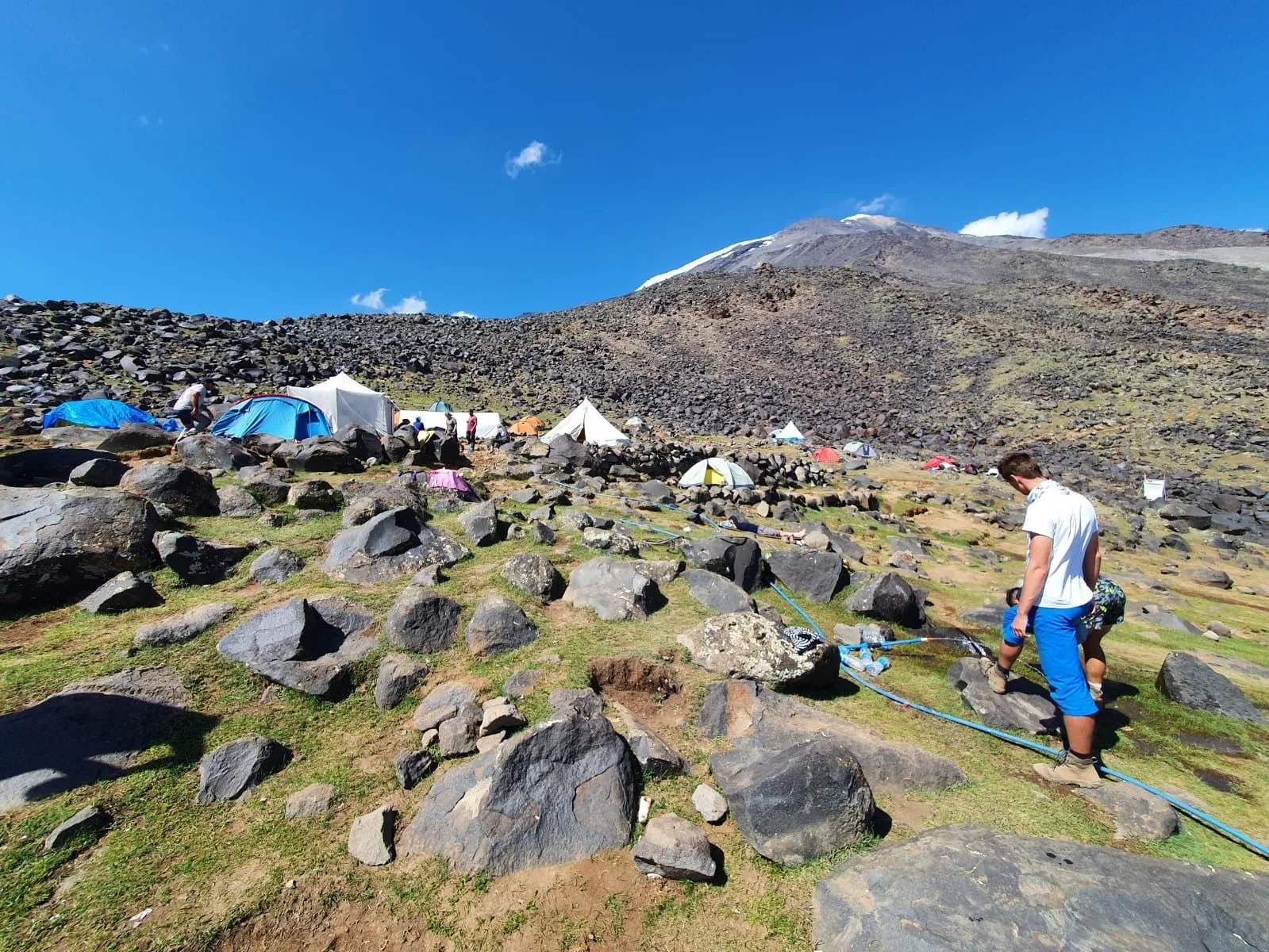
Around a thousand metres of ascent brings us to base camp at 3,200 metres, in a broad open bowl looking out over the valleys with the upper slopes of Ararat above. The support team have the tents up and a hot meal ready.
The air is cool and clean and the stillness that settles on the camp at sunset is one of the things people remember longest.
Today is the day that decides your summit, even though it does not feel like it at the time.
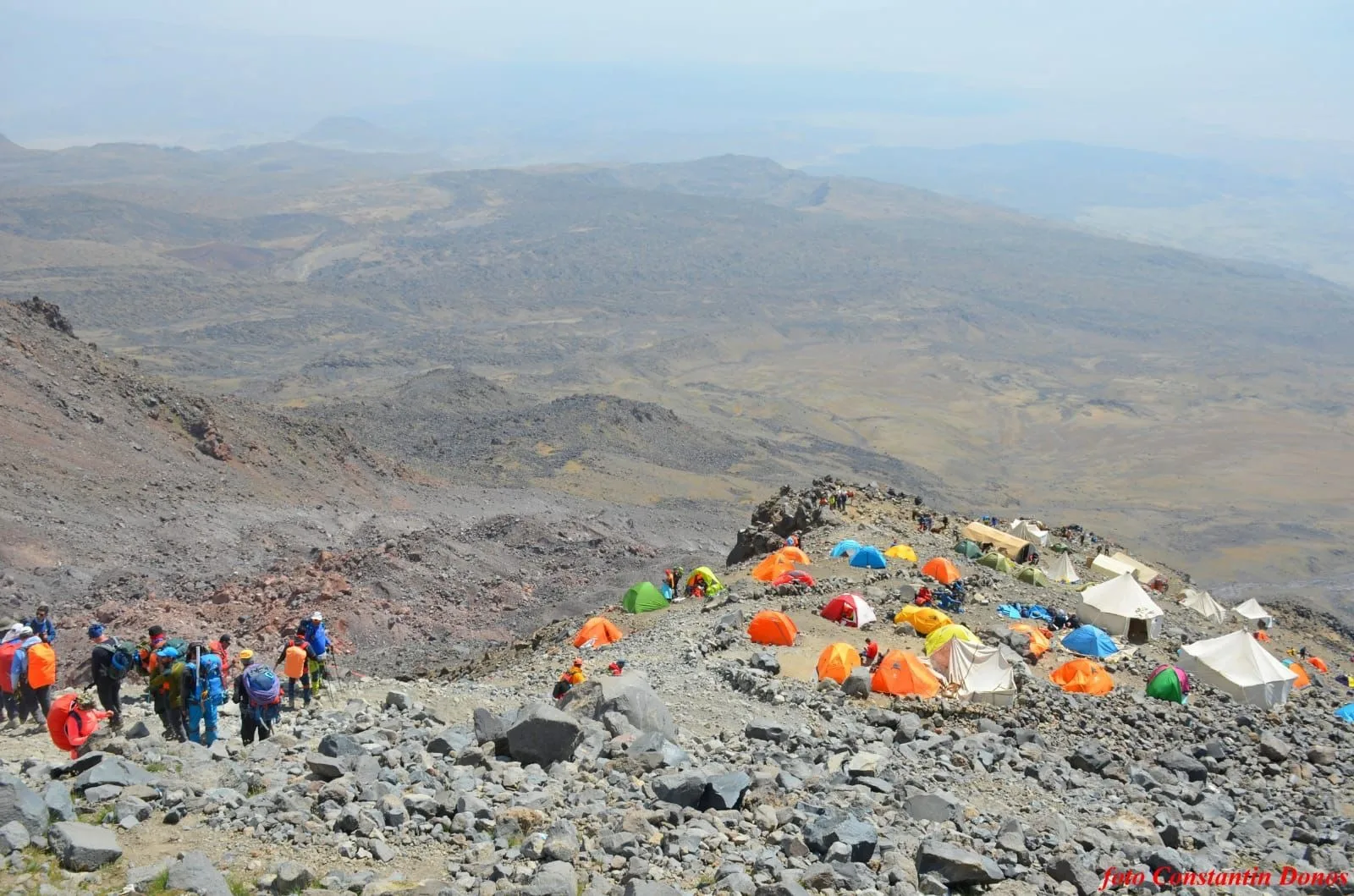
We climb from base camp up to around 4,200 metres, the site of the high camp, and spend a couple of hours up there letting your body do the work of adapting. The ground turns rocky and volcanic and the views open out enormously: sky above, a sea of cloud below, and a cold wind that reminds you exactly where you are.
Then we come back down and sleep at 3,200 metres. Climb high, sleep low. It feels like wasted effort while you are doing it and it is the single most useful thing you will do all week.
Back at base camp there is hot food, a chance to rest properly and an early night. Tomorrow we move up for good.
An early breakfast, then we pack up and climb the same ground we covered yesterday, this time carrying on to stay.
It is a steady three to four hour ascent over increasingly rocky, broken volcanic terrain, with plenty of stops to rest, drink and look at the view opening up underneath. The air is noticeably thinner and cooler and everything takes a little more effort than it should, which is entirely normal at this height.
We reach the high camp at 4,200 metres in time for lunch and set up in the raw upper landscape of the mountain. The rest of the day is deliberately empty: rest, eat, drink, sort your kit and let your body carry on adapting.
We eat early and go to bed absurdly early, because the alarm is going off in the middle of the night.
Summit day. We start climbing at around one or two in the morning under a sky absolutely full of stars, head torches strung out in a line, boots crunching on frozen ground, nobody saying very much.
The ascent takes five to seven hours over steep and often icy ground. Higher up we put crampons on for the summit ice cap, which is straightforward and fully briefed, and use an ice axe for balance. The air is thin and cold and every step costs something. This is the part the training was for.
Then the sky starts to lighten, and if the timing works you arrive on the summit at 5,137 metres just as the sun comes up. The highest point in Turkey, a view running out across borders and over a floor of cloud, and a feeling that is difficult to describe and impossible to forget.
We take photographs, we take it in, and then we go down carefully, back to high camp for a hot lunch. We pack up and continue down to base camp at 3,200 metres, arriving in the evening. It is a very long day, roughly eighteen hours from start to finish, and by the time you get in the mood in camp is somewhere between exhausted and euphoric.
A last breakfast on the mountain, then the walk down through the meadows to the trailhead and the drive back to Doğubayazıt.
What happens next is one of the best ideas on this whole expedition. You go to a traditional Turkish bath. Steam, hot marble, a scrub that removes several days of mountain, and a wash that will genuinely change how your legs feel about you. After six days of camping and a summit day of eighteen hours, it is close to a religious experience.
Then a proper bed, a proper bathroom, and a celebration barbecue with the team to mark what the group has just done together.
The rest of the evening is yours: rest, sleep, or wander into town. Most people manage about an hour of the third option before the first two win.
Breakfast, then the drive back north across the plain to Iğdır airport for your flight home, usually connecting through Istanbul.
As you drive away Ararat sits behind you on the horizon, exactly as improbable as it looked on the way in, except that now you have stood on top of it.

Founder and lead expedition leader
As the founder of Alexander Adventures, Joe has led successful expeditions across all seven continents. He is renowned for his expertise in mountaineering, mountain biking, trekking, scuba diving, kayaking, canoeing, and paddleboarding. With a deep commitment to safety, personal growth…
Leaders are confirmed close to departure and can change for operational reasons.
It is graded Hard, the third of our four grades. That is 8 days of it, so being ready matters more than being fast. The highest point is about 5,137m, so altitude is part of what makes it hard. If you are unsure whether it suits you, talk to us before you book rather than after: we would far rather move you to the right adventure than watch you struggle on the wrong one.
Every trip runs with qualified leaders, a risk assessment written for the route, emergency procedures and communications planned before departure, and local support on the ground. Travel insurance covering your chosen activities is a condition of booking.
The expedition begins and ends at Iğdır airport in far eastern Turkey. Flights are not included. Most guests fly from the UK via Istanbul, and your leader will advise on the recommended routing and timings so the group travels together. Allow generous connection times, and note that Day 1 is a travel day, so book to arrive at Iğdır on the morning of Day 2 and to depart on Day 8. Check your booking against those days before you pay.
Entry requirements for Turkey vary by nationality and have changed in recent years, with some nationalities now visa free for short tourist stays and others needing an e-visa obtained online in advance. Your passport should have at least six months validity beyond your travel dates. Confirm the current position for your own nationality against official guidance well before departure, and again shortly before you fly.
Mount Ararat sits in a permit controlled area and an official climbing permit is required, arranged in advance with the names and passport details of everyone in the group. We handle this, but it needs your passport details early, so add them to your guest portal as soon as you book. Nobody can be added at short notice. This is also a border region, so carry your passport at all times, expect military checkpoints on the roads, and follow your guide's lead at them.
Travel insurance is mandatory and there is one specific thing to check. Your policy must cover trekking to at least 5,137 metres and it must cover the use of crampons and an ice axe, which many policies exclude as winter mountaineering even when they cover trekking to altitude. Mountain rescue and repatriation cover matters here too, since this is a remote region. Read the activity list rather than assuming, and upload your policy number and your insurer's 24 hour emergency number to your guest portal before departure.
This is rated Hard. No previous mountaineering experience is required and there is no technical climbing, but you do need a good level of fitness. Summit day is around eighteen hours from leaving the tent to arriving at base camp, including roughly 900 metres of ascent and 1,900 metres of descent, at altitude, starting at one in the morning. If you can comfortably manage five or six hours of hill walking with 800 metres of ascent on consecutive days, you are in the right place.
The summit is 5,137 metres and the highest sleeping altitude is high camp at 4,200 metres. The itinerary includes a dedicated acclimatisation day climbing to 4,200 metres and returning to sleep at 3,200 metres, which is the single most important day of the trip. Mild symptoms are common and normal: headache, breathlessness, poor sleep and loss of appetite. Worsening headache, vomiting, breathlessness at rest, confusion or unsteadiness require descent, and the guides monitor the group daily with oximeters.
The upper mountain carries a permanent snow and ice cap, so crampons are worn and an ice axe carried for the summit push. No previous experience is needed and the team runs a full briefing before you step onto ice, but you must arrive with crampons that fit your boots, which means a stiff soled boot rated to take them. Hire can be arranged with advance notice. Compatibility is checked in Doğubayazıt at the start of the trip.
You camp for four nights on the mountain, three at base camp at 3,200 metres and one at high camp at 4,200 metres, in shared tents with the crew pitching camp and cooking hot meals. There are no facilities beyond what the team carries in, no showers and no charging. Nights are cold at base camp and considerably colder at high camp, so a four season sleeping bag is essential. It is simple, and it is also why the mountain feels like yours.
This departure runs in early July, in the main summer climbing season on Ararat. Doğubayazıt is hot and dry, often in the low thirties Celsius. It gets steadily colder with height: cool at base camp, cold at high camp, and well below freezing on the summit before dawn with significant wind chill. The upper mountain holds snow and ice year round. Pack for both extremes, which is not an exaggeration.
Full board is provided at the Doğubayazıt hotel and all meals are provided on the mountain, with hot food and drinks throughout the climb, cooked by the mountain crew. The food is simple, hearty and plentiful, which is exactly what you want at altitude. All water on the mountain is purified before drinking, and you should carry at least three litres of capacity plus your own purification as a backup. Dietary requirements can be accommodated, since everything is carried in, so add them to your guest portal when you book.
The currency is the Turkish lira. Cards are widely accepted in Doğubayazıt but you will need cash for tips, the Turkish bath, small purchases and anything on the road. There is no way to spend or withdraw money on the mountain, so draw what you need before you head up. ATMs are available in Doğubayazıt and Iğdır. Spend or change remaining lira before you fly home.
Tips for the mountain guides, the cook and the support crew are not included and are an important part of how mountain work is paid for here. Your expedition leader will advise sensible amounts, and the group traditionally puts it together and hands it over on the final evening. Bring this money in cash, in lira.
After the descent we visit a traditional hammam, which is included and which most guests describe as one of the best parts of the trip. Expect hot marble, steam, a vigorous scrub and a wash. Baths are usually separated by gender or run separate sessions. Bring swimwear or a towel wrap, and your leader will brief you on what to expect beforehand, since it is unfamiliar to most British visitors.
See a travel clinic or your GP well before departure to discuss Turkey and high altitude trekking. Routine vaccinations plus hepatitis A are commonly recommended. Stomach upsets are the main non altitude risk and are much more serious at 4,200 metres than at home, so purify all water, use hand sanitiser before eating, and carry rehydration sachets. Bring personal medication in hand luggage in original packaging. Any discussion of preventative altitude medication is for your own doctor.
The expedition operates in Ağrı and Iğdır provinces in far eastern Turkey, close to the Iranian and Armenian borders. We work with established local operators and the area we use is a well travelled mountaineering region, but it is sensible to read the current UK government travel advice for Turkey before you book and again before you travel, as you would anywhere. Carry your passport, expect checkpoints and follow your guide's lead.
The group is capped at ten and the trip is for adults aged eighteen and over. It suits solo travellers, couples and groups of friends who are fit, curious and want a real mountain without needing technical skills. It works particularly well as a first five thousand metre peak, and equally well for experienced trekkers who want somewhere genuinely uncrowded. Solo travellers are common and very welcome.
Your passport and flight details, insurance policy number and your insurer's 24 hour emergency number, medical information, emergency contacts and dietary requirements all go into your guest portal. Add your passport details as soon as you book, because the climbing permit depends on them. Everything else must be there no later than four weeks before departure.
Secure your place with a deposit today, then spread the balance interest free. How payment plans work
Not sure yet?
Talk it through with someone who has been there. Call 0191 903 9936 or send us a question.
| Dates | Availability | Price | Book |
|---|---|---|---|
| 1 - 8 July 2028 | Places available10 places left | £895 | Book this date |


A serious 7,000m expedition in the Pamirs that does not ask for a climbing CV.
From £4,995
£500 deposit to reserve, payment plans available
Seven days from the Caspian Sea to the highest point in Azerbaijan.
From £1,600
£320 deposit to reserve, payment plans available
Climb Jebel Toubkal, 4,167m, with Joe Alexander as he prepares for Everest.
From £795
£159 deposit to reserve, payment plans available