Kanchenjunga South Base Camp Trek
Sixteen days to the third highest mountain on earth, on a trail with nobody on it.
From £2,750
£550 deposit to reserve, payment plans available
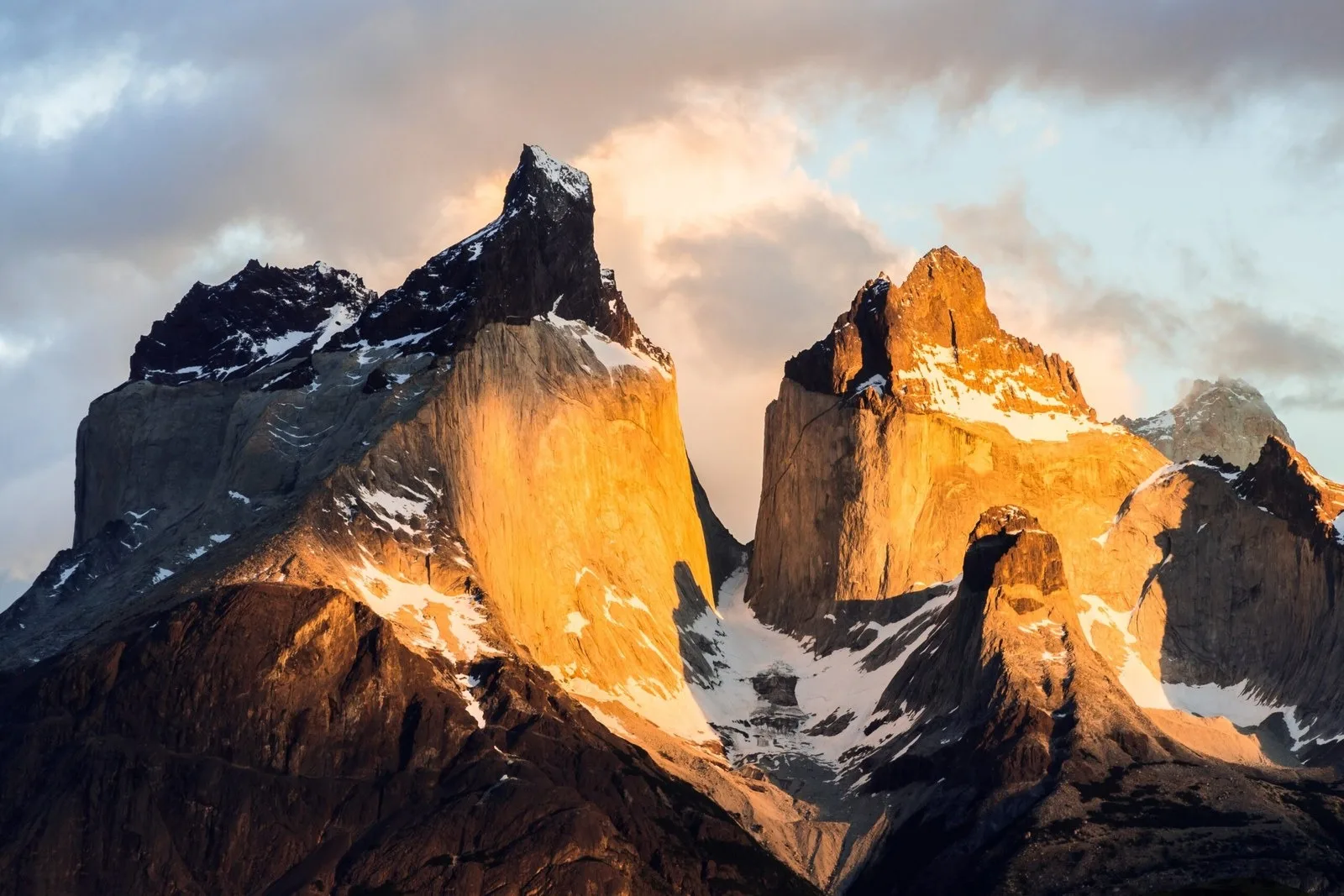
Twelve days in Chilean Patagonia walking the W Trek, from the granite towers at sunrise to the calving face of Grey Glacier, with proper rest days built in at each end and a lodge above the fjord to come home to.
There is a moment on the fourth day, after seven hours of walking and a final hour hauling yourself up a moraine of loose grey boulders, when the ground levels and the three towers are simply there: two and a half thousand metres of vertical granite standing over a lagoon the colour of milk and turquoise. People tend to go quiet.
This is the W Trek, the finest four days' walking in South America and the reason Torres del Paine has become the most famous national park in Chile. It is called the W because that is the shape the route traces across the Paine massif: up into the towers, west along the shore of Lake Nordenskjold beneath the black-capped Cuernos, up the French Valley to a natural amphitheatre of hanging glaciers, and finally north along Grey Lake to the ice.
We walk it west to east in reverse, starting with the hardest day while legs are fresh, and we do it without the two things that spoil most people's W. First, we carry nothing but a daypack: your main bag goes ahead to each refuge, and every tent, sleeping bag and mat is pitched and waiting when you arrive. Second, we are not in a hurry. Four trekking days sit inside a twelve day trip, with a full day in Puerto Natales before you start, a weather day held in reserve, and two proper days at the end to sleep, eat well and watch the light move across Ultima Esperanza Sound.
A warning worth giving early: Patagonia is not a gentle place. January is the warmest month here and it is also the windiest, with sustained winds around 35 km/h and gusts that regularly clear 100 km/h on the exposed sections. You will very likely get all four seasons in one afternoon. That is the trade, and everyone who has stood at the base of those towers considers it a bargain.
Depart the UK on your international flight bound for South America. British Airways fly non stop from Heathrow to Santiago in around fourteen and a half hours, and there are plentiful one stop routings through Madrid, Paris, Amsterdam or Sao Paulo if the timings suit you better.
This is a long travel day and there is no dressing it up. What it buys you is one of the great arrivals in travel: you go to sleep over the Atlantic and wake up in the southern hemisphere, with a connection waiting to take you a further three and a half hours south to Patagonia. Door to door, the UK to Puerto Natales is usually somewhere between twenty four and thirty hours.
One piece of admin worth doing before you leave the house. Chile requires every arriving passenger to complete an agricultural declaration, and it is free and takes two minutes online at ingresoachile.cl. It matters more than it sounds: trail food is exactly what gets confiscated, so buy your nuts, dried fruit and energy bars in Chile rather than carrying them across the border.
You land at Presidente Carlos Ibanez del Campo Airport at Punta Arenas, on the Strait of Magellan, where your driver will be waiting for the private transfer north to Puerto Natales. It is roughly 250 kilometres and three hours on the paved Ruta 9, and it is the drive that tells you where you have come to.
The Patagonian steppe runs flat and pale to the horizon in every direction, combed by a wind that never seems to stop. Guanacos graze in loose herds along the fenceline and scatter at the sound of the engine. Watch for nandu, the Darwin's rhea, running with their heads down, and for condors turning slowly on the thermals above the low escarpments. On a clear afternoon the first white peaks appear on the northern horizon an hour before you reach town, and that is the Paine massif.
Puerto Natales sits on Ultima Esperanza Sound, Last Hope Sound, named by a Spanish navigator who ran out of both. It is a small, brightly painted, wind-scoured town of corrugated iron and fishing boats, and it exists now almost entirely because of the park. You check into Weskar Lodge on the slope above the water, and gather for a welcome dinner looking out over the fjord.
A deliberate slow day. You have crossed nine thousand miles and eight time zones, and the Base of the Towers is not a walk to arrive at jetlagged. So this morning is yours: walk the waterfront promenade past the fishing boats and the Milodon sculpture, look through the artisan shops for wool and leather, or take the short climb to the Mirador Cerro Dorotea for a view back over the whole sound.
In the afternoon your leader runs the trip briefing and a kit check, and neither is a formality. Torres del Paine punishes bad kit in a specific and predictable way: the wind drives rain horizontally through anything that is not genuinely waterproof, and the moraine on Day 4 finds out any boot that has not been broken in. Anything missing can be bought or hired in Puerto Natales this afternoon, which is exactly why the day exists. Bring everything out and lay it on the bed.
This is also the day to draw cash. There are no cash machines anywhere inside the national park, and card terminals in the refuges are unreliable at the best of times. Banco de Chile and Banco Santander both have machines in town. In the evening we eat at Cormoran de las Rocas or similar, which does Patagonian lamb, king crab and the local seafood properly.
A 06:30 private transfer from the lodge, and the two and a half hour drive north across the steppe to the Laguna Amarga entrance. Torres del Paine covers over 227,000 hectares and has been a UNESCO Biosphere Reserve since 1978; your park entrance is included, and the QR codes are already on your leader's phone because there is no signal at the gate. Watch the roadside on this drive, at this hour, in this sector: it is the eastern steppe where the guanacos are, which means it is also where the pumas are.
At the Las Torres Welcome Centre you check in, leave your main bag at the refuge and set off with a daypack. This is the most famous trail in the park and the hardest day of the trek, so we do it first while legs are fresh. The operator's figure is around 18 kilometres round trip and about seven hours; the park's own signage says 20 kilometres and eight, and most groups land somewhere between. The trail climbs steadily from about 90 metres through the Ascencio valley, past Refugio Chileno, and into lenga forest along a river running grey with rock flour, with the enormous flank of Almirante Nieto above you the whole way.
The last kilometre is the one people remember. The path turns up a moraine of loose boulders and gains around 300 metres in roughly forty five minutes of hands-occasionally-on scrambling, and it feels considerably longer than that. Then the ground levels at 870 metres and the whole thing opens at once: Torre Sur, Torre Central and Torre Norte, sheer granite standing over a milky turquoise lagoon. Torre Central was first climbed in 1963 by Chris Bonington and Don Whillans. You come back down the same trail to Las Torres, and you will have earned your dinner.
An easier day after yesterday, and a beautiful one. The trail runs west from Las Torres along the southern shore of Lake Nordenskjold, a deep turquoise sheet of water 28 square kilometres in size that mirrors the peaks whenever the wind lets it. The operator's stage figure is around 11 kilometres in three and a half to four hours; the park's own table puts Las Torres to Los Cuernos at 11.6 kilometres and four and a half, with Frances a further hour beyond, so plan for a comfortable five to six hour day rather than a short one.
You walk through stretches of lenga, the southern beech that makes up almost all the forest here, where the path is soft and shaded and full of birdsong, and then out onto open exposed sections where the wind comes across the water without anything to slow it. This is the most exposed leg of the W and the one where people first understand the Patagonian wind properly. Lean into it and keep walking.
Ahead, all day, the Cuernos del Paine dominate the skyline: pale granite domes capped with a dark band of sedimentary rock, which is what gives the Horns their unmistakable two-tone silhouette and makes them the most photographed feature in the park. By mid afternoon you reach Frances, tucked into forest below the mouth of the French Valley, which is where tomorrow goes.
The longest day of the trek and, for a lot of people, the best. Expect nine to ten hours on the trail and up to 18.8 kilometres if you go to the top viewpoint, so we leave early and we watch the clock.
From Frances the trail drops to Campamento Italiano and then turns north into the Valle del Frances, climbing steadily through dense lenga. Almost immediately you become aware of the noise: the French Glacier hangs on the wall opposite and sheds ice more or less continuously through the morning, and the crack and roar of avalanches echoing round the valley is a sound nobody forgets. There are two decision points. The first lookout, Mirador Frances at around 680 metres, gives you the glacier and the cliffs and is a perfectly good day in itself. Beyond it the trail steepens for a further three kilometres to Mirador Britanico at the head of the valley.
Britanico is a full 360 degree amphitheatre of granite: the north face of Paine Grande, Cerro Catedral, Cota 2000, Aleta de Tiburon (the Shark's Fin) and the back of the Cuernos, standing round you in a ring. It is one of the great mountain viewpoints anywhere. The one hard rule is the clock: the Italiano ranger station closes the Britanico branch at 16:00 and it is enforced, so the valley is a morning push, not an afternoon amble.
Back down the valley, you rejoin the W and turn west along the shore of Lake Pehoe with the enormous bulk of Cerro Paine Grande above you, reaching Refugio Paine Grande in the evening. It is the biggest and busiest place you will sleep in the park, a proper crossroads for the W and the O circuits, and there is a bar with a view of the lake.
A medium day and the most consistently scenic on the route: 11 kilometres and three and a half to four hours from Paine Grande to Refugio Grey, rolling rather than climbing, with roughly 430 metres of ascent spread across the whole leg.
An hour in, the trail crosses the Quebrada de los Vientos, the Gorge of the Winds, which is exactly what its name suggests and is also where you get your first sight of Grey Glacier away to the north. Much of this section runs through the scar of the 2011 fire, started by a trekker burning toilet paper, which took 17,000 hectares. The standing dead lenga will be there for a century before real forest returns, and it is the most eloquent argument for the park's absolute fire rules that anyone could make.
From there the path undulates along the eastern shore of Lago Grey with icebergs drifting down the water towards you, some of them the deep bottle blue that only very old, very compressed ice goes. The glacier grows with every headland. Grey is one of the major outlet glaciers of the Southern Patagonian Ice Field, the second largest continuous ice field outside the poles at around 16,500 square kilometres. The glacier itself was surveyed at 270 square kilometres and 28 kilometres long, with a face around six kilometres wide standing more than 30 metres above the lake.
You arrive at Grey in the afternoon. If there is energy left, the trail continues north to a pair of hanging suspension bridges, roughly two and three and a half kilometres beyond the campsite, and they give the finest elevated view of the ice field in the park.
Your final walking day, and it retraces yesterday's route: 11 kilometres and three and a half to four hours back along Lago Grey to Paine Grande. It is a very different walk in this direction. The icebergs are behind you now and it is the massif you are walking towards, with the Cuernos and Paine Grande growing all afternoon, and the wind is more often at your back than in your face.
Back at Paine Grande there is time to sit outside with a drink and watch the light move on the lake before the catamaran. The crossing of Lake Pehoe takes around thirty minutes over roughly eleven kilometres of the most extraordinary turquoise water, with the whole massif standing behind you as it recedes. Your ticket is included. It is a genuinely lovely way to leave a mountain range, and considerably better than walking out.
At the Pudeto dock a private transfer is waiting for the drive back to Puerto Natales. After four days of tents and refuge dormitories, Weskar Lodge and a hot shower land very well indeed, and dinner tonight is the one where the trip becomes a story rather than an effort.
After four days of walking, a day with nothing in it. Puerto Natales is a good place to do nothing: brightly painted corrugated iron houses, a working fishing waterfront, and a laid back frontier feel that has survived the park's success better than you might expect.
Walk the promenade and watch the boats come in. The Municipal History Museum is small and genuinely interesting on the region's Tehuelche past, the sheep estancia boom and the German and Croatian settlers who built the town. The artisan shops sell serious wool. Or find a cafe with a window on the sound, order something hot, and watch the weather come across the water, which is a legitimate way to spend an afternoon here.
Practically, this is the day for laundry, for sorting gear and photographs, and for eating properly. Patagonian lamb cooked slowly over an open fire, king crab from the fjords, and calafate berries in more or less everything. The local legend says that anyone who eats calafate will return to Patagonia, which as sales pitches go is one of the more effective ones.
A second free day, and it is in the itinerary on purpose. Most Patagonia trips run you straight from the last refuge to the airport, and the people who have done it that way generally wish they had not. Two days here means you go home rested rather than wrecked, and it means the town gets a fair look rather than a glance.
If you would rather be doing something, there is plenty within reach, all at your own cost and easily arranged through the lodge. The Cueva del Milodon is twenty five minutes out of town, an enormous cave where the remains of a giant ground sloth were found in 1895 and where Bruce Chatwin's In Patagonia begins. Boat trips run up Ultima Esperanza Sound to the Balmaceda and Serrano glaciers, a full day on the water with sea lions and cormorant colonies along the way. There is horse riding on the estancias, sea kayaking on the sound, and half a dozen short walks around the town.
Or do none of it. The wind comes off the water, the light changes every twenty minutes, and there is a fire in the lounge.
This day exists because of the wind. Torres del Paine takes weather seriously enough that any honest twelve day itinerary keeps a day in hand, and this is it. If a trekking day was cut short, a viewpoint was closed by conditions, or the catamaran did not run when it should have, this is the day we use to put it right, and having it in reserve is what lets your leader make a safe call on the mountain instead of a stubborn one.
In most years it is not needed, and then it becomes the best kind of day: a last unhurried one in Patagonia with no alarm set. Take a short walk to Mirador Cerro Dorotea for the long view over the sound. Buy the things you have been looking at all week. Photograph the boats. Sit somewhere warm and start assembling the story you are going to tell when you get home.
It is also, quietly, the last full day. The wind off the water in the evening, the low light at ten at night because you are at fifty two degrees south, the mountains you walked in still visible on the northern horizon on a clear day. Worth being outside for.
Breakfast, check out, and the transfer south. Depending on flight timings this is either the three hour drive back down Ruta 9 to Punta Arenas airport, or the seasonal direct service from Puerto Natales where the schedule allows it. Then north to Santiago and, after a connection, the long haul across the Atlantic home.
It is a long way back, and there is time on it to let the trip settle. Four days on foot through one of the most spectacular mountain landscapes on earth, three granite towers above a lagoon at 870 metres, an amphitheatre of hanging glaciers, an ice wall at the end of a 28 kilometre glacier, and a wind that most people end up rather fond of once they are safely out of it.
Eat a calafate berry before you go. The legend is quite specific about what happens next.
It is graded Hard, the third of our four grades. That is 12 days of it, so being ready matters more than being fast. If you are unsure whether it suits you, talk to us before you book rather than after: we would far rather move you to the right adventure than watch you struggle on the wrong one.
Every trip runs with qualified leaders, a risk assessment written for the route, emergency procedures and communications planned before departure, and local support on the ground. Travel insurance covering your chosen activities is a condition of booking.
British citizens need no visa to visit Chile as a tourist and may stay for up to 90 days. Your passport must be valid beyond your intended date of departure from Chile; there is no six month rule. There is no reciprocity or entry fee. On arrival, immigration will issue you a Tarjeta de Turismo, a white A5 tourist card. Keep it: you must surrender it when you leave the country, and replacing a lost one means a queue at the PDI police office and can cost you a flight. Photograph it, and keep the paper copy with your passport rather than in a bag that goes into a refuge locker. Please check the FCDO travel advice for Chile before you travel, as requirements can change.
Chile enforces strict agricultural biosecurity and every arriving passenger must complete a SAG sworn declaration. It is free and takes two minutes online at ingresoachile.cl before you travel. You must declare all products of plant or animal origin regardless of quantity or packaging: fresh fruit, nuts, seeds, honey, dried and cured meat, cheese and other dairy, and anything made from plant or animal material. This catches trekkers more than anyone else, because trail mix, dried fruit, jerky, hard cheese and seeded energy bars are exactly what gets seized. Fines start in the hundreds of thousands of pesos and have run far higher in enforcement cases, and undeclared goods are destroyed. The simple answer: buy your snacks in Puerto Natales, where the supermarkets are entirely adequate, and declare anything you are unsure about, because declaring costs nothing.
This is graded Hard, the third of our four grades, and the difficulty is neither technical nor altitude related. There is no climbing, no scrambling beyond a short hands-on section of moraine, no exposure and no equipment to learn. What it asks is four consecutive walking days on rough mountain trails: two of them at seven to ten hours with substantial ascent and descent, and two at four to six. You should be comfortable walking six to seven hours on hill ground carrying a daypack, on consecutive days, and you should have trained for that specifically rather than for one hard day. The wind adds a layer that a British hill day does not, and it is genuinely tiring in a way people do not anticipate. Our pre departure training programme starts sixteen weeks out and is built around exactly this.
Worth stating plainly, because guests comparing this to Kilimanjaro or Everest Base Camp often assume otherwise. The highest point of the W Trek is the Mirador Base Las Torres at 870 metres, and the trailhead below it sits at about 90 metres. There is no acclimatisation requirement whatsoever, no altitude medication to consider, and no altitude related risk on this itinerary. Torres del Paine delivers genuine high mountain scenery at what is, in altitude terms, hill walking height. The difficulty here is entirely distance, wind, weather and consecutive days on your feet.
Expect all four seasons in a day, and plan for the wind above everything. In January, the park averages daytime highs around 18C and overnight lows around 7C, with roughly 45mm of rain spread across about eleven days of the month, so rain is frequent but usually short lived. The wind is the part that surprises people: average speeds run around 35 km/h and gusts regularly exceed 100 km/h on exposed sections, strong enough to knock a walker off balance. Counter intuitively, the warmest months here are also the windiest, with November to January the most intense wind season of the year. This is why genuinely windproof and waterproof outer layers matter more than any other item of kit, and why we hold a weather reserve day in the itinerary.
You will sleep in three pitched campsites (Las Torres, Frances and Grey) and one refuge dormitory (Paine Grande) during the trek, and at Weskar Lodge in Puerto Natales for the five nights either side. The camping is comfortable rather than hardy: tents are already pitched when you arrive, and sleeping bags and mats are provided, so you never carry heavy equipment. All four park accommodations have shared toilets, hot showers and a sheltered dining area where meals are served. Paine Grande is the largest and busiest, with dormitory bunk beds, a shop and a bar overlooking Lake Pehoe. Reservations inside the park are compulsory for every night and rangers do check them, which is why all bookings are made and confirmed in advance on your behalf across the park's three separate booking systems.
All meals are included from the moment you enter the park: breakfast, a packed trail lunch and a cooked dinner every trekking day. Expect hearty rather than refined food, with plenty of it, and plenty of tea and coffee. Drinking water is potable at all park accommodations, and stream water on the trail is generally safe if taken from fast flowing secondary streams rather than the main rivers or anything standing; a lightweight filter or purification tablets are cheap insurance. In Puerto Natales the tap water is treated and safe, and the local food is a real pleasure: Patagonian lamb cooked slowly over fire, king crab from the sound, and calafate berries in everything. Vegetarians are easily catered for. Vegan, gluten free and any serious allergy must be noted in the guest portal so the refuges can plan, and please understand that the range in the park is limited.
Chile uses the Chilean peso. There are no cash machines and no currency exchange anywhere inside Torres del Paine National Park, so all cash must be drawn in Puerto Natales, where Banco de Chile and Banco Santander both have machines and there are several exchange offices in the centre, typically open from mid morning to mid afternoon with a lunch closure. Card terminals do exist at some refuges but connectivity in the park is poor and they are not reliable, so treat cards as a bonus rather than a plan and carry enough pesos in small denominations for the whole trek. What you need cash for: drinks and bar purchases, snacks, paid wifi, laundry, souvenirs and tips. Tipping is customary and not included, and your leader will suggest amounts before you go.
See a travel clinic at least eight weeks before departure and take the itinerary with you. Typical advice for Chile is routine UK immunisations up to date, particularly tetanus, plus hepatitis A and possibly typhoid for adventure travellers in rural areas. There is no yellow fever requirement and no malaria risk. One current item you should know about: Chile's Ministry of Health declared a national hantavirus health alert in July 2026 covering all regions from Atacama to Magallanes, which includes Patagonia, running to July 2027. Hantavirus is carried by a native rodent and transmitted by inhaling aerosolised droppings, so the precautions are practical ones: keep all food and rubbish sealed, ventilate any enclosed building before entering, and do not sleep directly on the ground outside a tent. Your leader will brief this properly before we enter the park. Bring personal medication in its original packaging with a copy of the prescription.
Comprehensive travel insurance is a condition of joining this trip. Your policy must explicitly cover trekking, search and rescue, and emergency evacuation and repatriation. Read the policy wording rather than the summary, and get confirmation by email if trekking is not clearly named. One Patagonia specific point worth understanding: helicopter evacuation from the park is often impossible, because the wind that causes an emergency is the same wind that grounds the aircraft. Ground evacuation from a remote section can mean a stretcher or horseback carry to the nearest vehicle track, then a three hour drive to Puerto Natales. Make sure your cover extends to extended ground evacuation and to repatriation, not only to a helicopter. Please update your policy number and your insurer's 24 hour emergency line on your guest portal before departure.
Assume there is no mobile signal inside Torres del Paine. In practice coverage is patchy rather than absolutely nil, with occasional signal in the eastern sector and around Paine Grande depending on carrier, but it cannot be relied on and you should not plan around being contactable. Most refuges and campsites sell wifi vouchers, which work variably. Your leader carries a satellite communicator for the whole trek and the group's emergency contacts. Chile's emergency numbers are 131 for ambulance, 132 for fire and 133 for police. Rescue in the park is coordinated by CONAF rangers with Carabineros and can be slow. The provincial hospital is Hospital Dr Augusto Essmann Burgos in Puerto Natales, which has an emergency department, imaging and operating theatres; anything more serious goes on to Punta Arenas, three hours further south. Please tell family at home that you will be out of contact for four days.
Torres del Paine has lost enormous areas of irreplaceable forest to trekker caused fires: around 15,000 hectares in 2005 from an overturned camping stove, and around 17,000 hectares in 2011 from a trekker burning toilet paper. You walk through the standing dead trees of the 2011 fire on the Grey leg, and the burnt beech forest will take roughly a century to recover. So: open fires are prohibited outright, stoves may only be used in designated cooking areas at authorised campsites, and smoking anywhere in the park results in immediate expulsion. Penalties under Chilean law run to substantial fines and imprisonment. Drones are prohibited. Camp only in authorised areas, stay on marked trails, register at every ranger station, and observe the posted trail closing times, which are enforced and exist to stop people being caught out after dark.
Torres del Paine holds 25 mammal and around 126 bird species. Guanacos are all but guaranteed, particularly on the drive in through the eastern steppe and around the Base Torres trailhead early in the morning, and they are the animal that anchors the whole ecosystem. Andean condors are likely, usually as distant birds turning on the thermals, occasionally very close; the wingspan reaches three metres and more. Foxes are regularly seen. Two honest caveats. The park has the densest known puma population anywhere on earth, estimated by researchers at a couple of hundred in the region, but they are shy, crepuscular and concentrated in the eastern steppe rather than along the trekking corridor, so a sighting is a stroke of luck and never a scheduled item. And the huemul, the endangered Andean deer on Chile's coat of arms with fewer than 1,500 left in the wild, is a once in a lifetime encounter that we will not pretend to be able to arrange.
International and internal flights are not included. British Airways operates a non stop service from London Heathrow to Santiago taking around fourteen and a half hours, though frequency is seasonal and worth checking; there are plentiful one stop alternatives through Madrid, Paris, Amsterdam or Sao Paulo. From Santiago, LATAM, JetSMART and SKY all fly to Punta Arenas in about three and a half hours, and seasonal direct flights to Puerto Natales operate roughly November to March a few times a week, which removes the road transfer entirely where the timing fits. Allow at least three hours for the Santiago connection, as it involves a terminal change and bags are usually rechecked. Door to door, the UK to Puerto Natales is realistically 24 to 30 hours. Please add your flight details to your guest portal as soon as they are booked so we can build the transfers around them.
The Magallanes region, which includes Puerto Natales and Torres del Paine, keeps UTC minus 3 all year round and does not change its clocks, which is unusual even within Chile. In the southern summer that puts it three hours behind GMT and four hours behind British Summer Time, and level with Santiago. The practical effect is worth knowing about. Puerto Natales sits at nearly 52 degrees south, so mid January brings around sixteen and a half hours of daylight, and combined with the permanent UTC minus 3 the sun sets somewhere close to ten in the evening. You will eat dinner in broad daylight, and usable light for walking runs from very early to very late, which is what makes an early start for the towers entirely practical.
This trip runs with a maximum of twelve guests, accompanied by your Alexander Adventures expedition leader and experienced local Patagonian guides. Accommodation is on a twin share basis throughout: double or twin rooms at the lodge, two person tents at the campsites, and shared dormitory bunks at Paine Grande. If you are travelling alone we will pair you with another guest of the same sex, and if you would prefer your own room a single supplement is available on request for the Puerto Natales nights. Please ask at the time of booking rather than later, because refuge and campsite spaces in Torres del Paine are booked many months in advance and cannot be changed easily.
Secure your place with a deposit today, then spread the balance interest free. How payment plans work
Not sure yet?
Talk it through with someone who has been there. Call 0191 903 9936 or send us a question.
| Dates | Availability | Price | Book |
|---|---|---|---|
| 8 - 19 January 2028 | Places available12 places left | £2,900 | Book this date |
Sixteen days to the third highest mountain on earth, on a trail with nobody on it.
From £2,750
£550 deposit to reserve, payment plans available
A night camped at Everest Base Camp, in the year Joe Alexander climbs Everest.
From £2,500
£500 deposit to reserve, payment plans available
Everest Base Camp led by Joe Alexander, with two acclimatisation days and a medic.
From £2,595
£519 deposit to reserve, payment plans available