

Madagascar: Easy Island Adventure
All the wildlife of Madagascar, none of the hard expedition.
From £1,995
£399 deposit to reserve, payment plans available
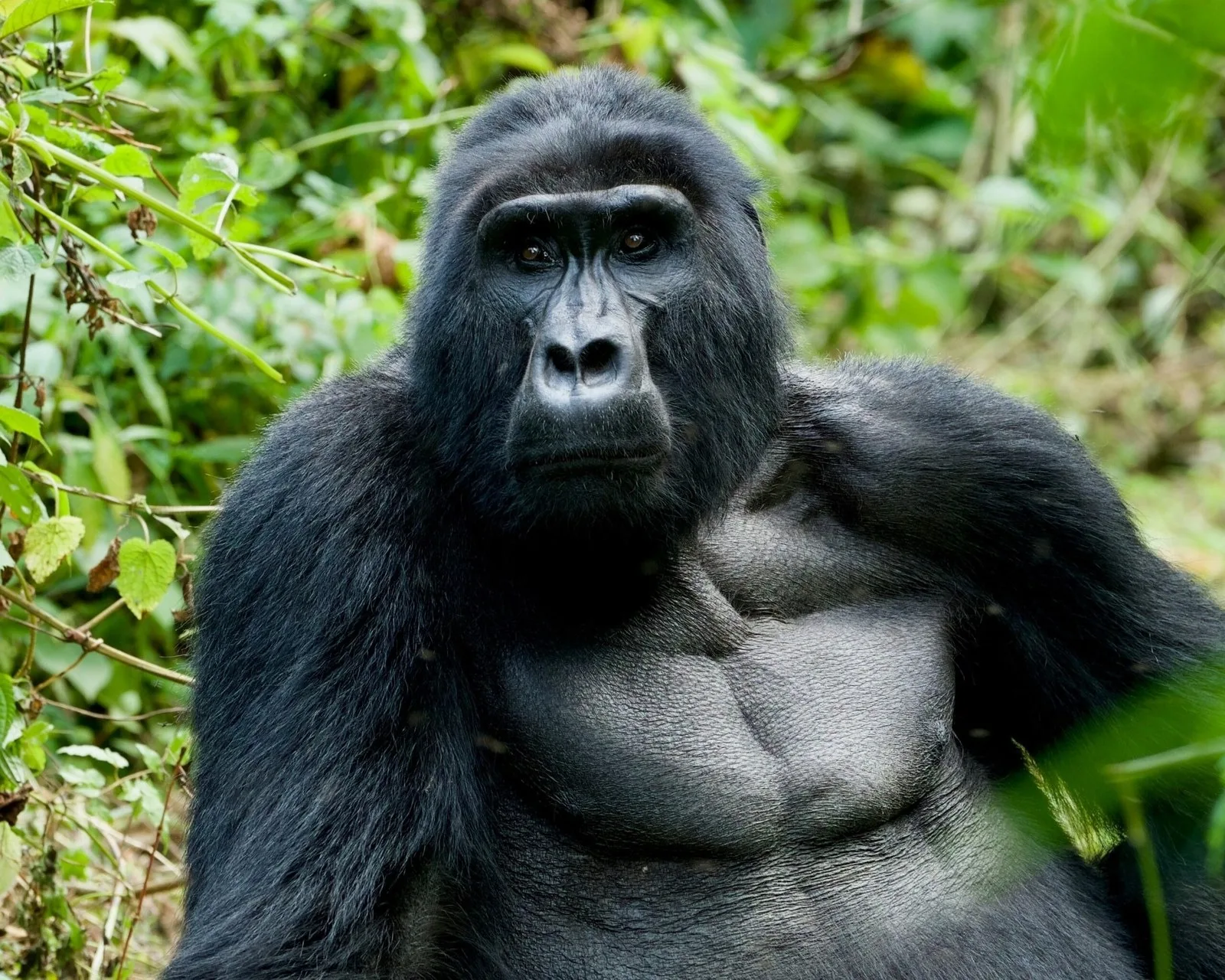
There is a moment in Bwindi when the tracker in front of you stops, holds up a hand, and everything goes quiet except your own breathing. Somewhere in the wall of green ahead, something very large shifts its weight. Then the leaves part and you are looking at a silverback mountain gorilla, at a distance measured in metres, in the forest that holds nearly half the world's remaining population.
Uganda packs more into a small country than almost anywhere in Africa. In ten days we go from the rainforested highlands of the southwest, where the Albertine Rift throws up ridge after ridge of improbable green, out onto the savannah of Queen Elizabeth National Park with the Rwenzoris on the horizon, and then east to Jinja, where the White Nile leaves Lake Victoria and immediately starts behaving badly. Elephants at dawn on the Kasenyi plains. Hundreds of hippos on the Kazinga Channel at sunset. Two days of grade 3 to grade 5 water with professional safety kayakers, and a riverside barbecue afterwards to talk about the bits where you fell in.
Between the wildlife and the whitewater there is the country itself: the Batwa, the original forest people of Bwindi, telling their own story in their own words; a photograph astride the equator on the Masaka road; tea plantations, banana groves, market towns and children who will wave at the vehicle for a full minute. The lodges are good, the food is better than most people expect, and the group is capped at ten.
Led throughout by Joe Alexander with expert Ugandan guides. Adventure, wildlife, culture and adrenaline in one trip, which is precisely the point.
You land at Entebbe International Airport on a peninsula sticking out into Lake Victoria, and the first thing you notice is that it is green, warm and unhurried. The Alexander Adventures team will be waiting past immigration, and the transfer to your hotel takes about fifteen minutes through Entebbe's fig trees and bougainvillea.
There is nothing to do this afternoon except stop travelling. The hotel sits minutes from the lake shore, with gardens, a pool and the sort of veranda that ruins your intentions of unpacking properly. Marabou storks sit in the trees like disapproving undertakers. If your flight lands early enough, the botanical gardens are a ten minute walk and full of birds.
At around five we gather for the welcome dinner with Joe and your Ugandan guide. This is where the group becomes a group: introductions, the shape of the next ten days, how the gorilla trek actually works, what the rafting involves and what it does not, kit checks, insurance and medical declarations, and every question anyone wants to ask. Then an early night, because tomorrow is a long day whichever way we travel.
Today we cross the country to the southwest, and there are two ways of doing it. The internal flight takes around an hour to the airstrip nearest Bwindi and hands you back most of a day, with the added pleasure of seeing Uganda's lakes, craters and forest ridges from the air. The road transfer takes eight to nine hours in a private vehicle and is a genuinely good day out, not a chore.
If we drive, the route runs southwest on the Masaka road through banana plantations and roadside markets selling everything from grilled maize to live chickens. There is the obligatory stop at the equator monument at Kayabwe, where somebody always insists on standing with one foot in each hemisphere, and a proper lunch stop en route. The last stretch climbs into the highlands and the landscape changes completely: tea estates, terraced hillsides worked to their summits, and then the forest itself, a dark unbroken canopy filling every valley.
Either way you arrive in Bwindi in the late afternoon and settle into the eco-lodge as the mist starts to roll down off the ridges. Dinner, an early briefing on tomorrow's trek, and bed. The forest makes noises all night. That is normal.
Breakfast in the dark, then to the park headquarters for the ranger briefing at around eight. Groups are allocated to gorilla families, porters are hired (do take one, it is the best money you will spend all trip and it puts income straight into the villages around the park), and then you walk into the forest.
Bwindi is not a gentle wood. It is 321 square kilometres of montane rainforest between roughly 1,160m and 2,600m, more than half of it above 2,000m, and the name is not marketing. The trails are steep, root laced, frequently muddy and occasionally require the rangers to cut a way through with machetes. Trekking time depends entirely on where the family has moved overnight: sometimes ninety minutes, sometimes most of the day. Expect anything from two to eight hours on your feet in total, and expect to be filthy.
Then the trackers stop, packs go down, masks go on, and you walk the last few metres. A habituated family will carry on doing exactly what it was doing: a silverback dozing with one eye open, females feeding, juveniles falling out of trees for the sheer entertainment of it. The hour goes in about ten minutes. Back at the lodge there is hot water, cold beer and a campfire dinner where nobody talks about anything else all evening.
This morning belongs to the Batwa, the forest people who lived in and from Bwindi for millennia before it became a national park in 1991 and they were moved out of it. They will welcome the group with song and dance, and then tell their own story: how they hunted, which plants they used for what, how fire was made, where the sacred sites were, and what has happened to them since. It is warm, funny and occasionally uncomfortable, which is the honest version of a cultural visit and much better than the alternative. The money goes directly into the community.
In the afternoon you choose. A second gorilla permit is included, so you can go back into the forest to a different family, which is a genuinely different experience: different terrain, different personalities, and you already know what you are doing. Or you can take a guided forest hike instead, following the trails to the waterfalls through a canopy holding more than 350 bird species, ten primate species and 220 species of tree, with a guide who can name most of them.
By late afternoon everyone converges on the lodge terrace. There are massages available from local therapists, there are sundowners, and there is the forest going dark below you while the hornbills make their last runs across the valley.
After breakfast we leave the forest and drive north to Queen Elizabeth National Park, five to six hours through rolling hill country, terraced smallholdings and villages where the whole road turns out to watch you go by. The landscape opens out as you drop, forest giving way to scrub and then to savannah, with crater lakes off to the side and the Rwenzori Mountains beginning to show themselves in the west.
Queen Elizabeth covers 1,978 square kilometres between Lake Edward and Lake George, holds 95 mammal species and more than 600 bird species, and is Uganda's most visited park for good reason. We check into the lodge, take a short breather, and head out on an afternoon game drive across open plains dotted with candelabra euphorbia. Elephant, buffalo, Uganda kob, warthog and waterbuck are all but certain; lion are common and often visible as the day cools.
In the early evening we board a boat on the Kazinga Channel, the 32 kilometre natural waterway linking the two lakes. This is the trip's most reliable wildlife hour. Hippos in their hundreds, Nile crocodiles hauled out on the banks, buffalo standing in the shallows, elephants coming down to drink, and a wall of birds: African fish eagles, pied and malachite kingfishers, pelicans, skimmers and storks. The light goes gold, then orange, and then you go and have dinner.
Coffee at five and out in the dark. The Kasenyi plains, the open grassland running down towards Lake George, are Queen Elizabeth's best game viewing and they are best at first light. This is the park's prime lion territory, hunting over an enormous resident population of Uganda kob, and dawn is when it happens. Elephant move across the grass in silhouette, buffalo shake off the night, the light comes up pink and then hard white, and the whole thing is over by seven.
Breakfast back at the lodge, and then east. Jinja is the other side of the country, so again there are two options: an internal flight, quick and comfortable with fine views of the lakes and the Nile, or a full day road transfer that becomes part of the adventure. If we drive, we stop for markets, for viewpoints, for the equator again if the route takes us that way, and for lunch, and we arrive in the late afternoon.
Jinja sits where the White Nile leaves Lake Victoria and begins its 6,650 kilometre run to the Mediterranean. It is a low-slung colonial-era town gone slightly to seed in a very likeable way, and it has been East Africa's adventure capital for thirty years. We settle into the riverside camp and spend the evening on the bank, watching the river go by and pretending we are not thinking about tomorrow.
The White Nile below Jinja is one of the two or three best one day whitewater trips on the planet, and the reason is simple: the volume of water is enormous, it is warm, the rapids are big and clean, and the pools between them are deep, wide and forgiving. You will spend the day being thrown around by water that would be genuinely dangerous somewhere with rocks in it, and here is mostly just enormous fun.
After a briefing and a practice flip in flat water, we run roughly 15 kilometres of river over four to five hours. The rapids come in sets: long, roaring grade 4 and 5 wave trains with names the guides deliver with obvious relish, separated by calm stretches where you can float, swim, and watch fish eagles and cormorants working the banks. Every trip runs with a full safety raft and safety kayakers alongside, and the river crews here are among the most experienced and best qualified in the world.
Crucially, this is not all or nothing. Every big rapid has a line: the guides will run the full grade 5 route with anyone who wants it, take a softer line through the same rapid for anyone who does not, and portage anybody who would rather walk round. There is also the option of a gentler float trip or a tandem kayak with a guide. Nobody is pushed and nobody is judged.
Lunch is a riverside barbecue on the bank, and the celebratory drinks afterwards are, by long tradition, taken while everybody watches the photographer's footage of the moment their raft went over.
Today is yours to build, and the second rafting day is already included if you want it. Going back on the river with a day's experience behind you is a completely different proposition: you know what a wave train does, you have already fallen in, and you spend far more of the day paddling and far less of it worrying.
If once was enough, Jinja has no shortage of alternatives. Tandem kayaking with a guide on the calmer stretches gets you closer to the water and the birdlife. Riverboarding, also called hydrospeed, involves lying on a board with fins and taking on the rapids at eye level, and is the most adrenal thing available here by some margin. On land there is quad biking through villages and along the riverbank tracks, and horse riding through the countryside at a considerably gentler pace.
Or you can change register entirely and visit a chimpanzee sanctuary, where rescued and orphaned chimpanzees live in a large area of protected forest. It is an easy, moving few hours: you watch a feed, you hear about the trade that puts them there in the first place, and you leave with a reasonably clear view of what conservation actually costs.
In the evening we gather on the riverbank for the farewell dinner, with lanterns, good food and the sound of the Nile going past. This is the one where somebody makes a speech.
The last full day, and again there is a choice about how to spend it. The drive back to Entebbe is around three to four hours by road, or you can take a short internal flight and be there before lunch. The road option means one more pass through the countryside, with photo stops, roadside markets and the crossing of the Nile at Jinja for the last time.
Entebbe is a good place to end. The craft markets are the best in the country for wood carving, bark cloth, beadwork and printed fabric, and the prices are reasonable if the haggling is good natured. If shopping is not your idea of a final day, the Entebbe Botanical Gardens run down to the shore of Lake Victoria and are worth a couple of hours on their own: enormous fig and mahogany trees, black and white colobus monkeys in the canopy, and around 200 bird species including some spectacular kingfishers and turacos.
In the evening we take a table at a lakeside restaurant and watch the sun go down over Lake Victoria with a cold drink, which after nine days of pre-dawn starts, forest mud and cold river water feels entirely earned.
A slow breakfast, a last look at the lake, and then the short transfer to Entebbe International Airport, timed around the group's flights. Your leader will see everybody through check in, which at Entebbe is worth having: the security screening happens twice and the queues are unpredictable.
For anyone not ready to go home, this is a good place to be standing. Zanzibar is a short hop for white sand, coral reefs and the alleyways of Stone Town. Kenya is next door for the Maasai Mara and the Big Five, and if your timing is right, the migration. Or you can stay in Uganda and go quiet at Lake Bunyonyi in the southwest, a deep, island-dotted lake at 1,960m surrounded by terraced hills, with no bilharzia, no crocodiles and no hippos, which makes it one of the few lakes in East Africa you can actually swim in. Canoes, birds, hammocks, and absolutely nothing to do.
Whatever you choose, you leave with mud that will not come off your boots, a phone full of photographs that do not do the gorillas justice, and the particular satisfaction of having done a country properly rather than skimming it.
It is graded Medium, the second of our four grades. That is 10 days of it, so being ready matters more than being fast. The highest point is about 2,600m, so altitude is part of what makes it hard. If you are unsure whether it suits you, talk to us before you book rather than after: we would far rather move you to the right adventure than watch you struggle on the wrong one.
Every trip runs with qualified leaders, a risk assessment written for the route, emergency procedures and communications planned before departure, and local support on the ground. Travel insurance covering your chosen activities is a condition of booking.
British nationals and most other nationalities need a visa to enter Uganda, and it must be applied for online in advance through the official Ugandan immigration portal. Applications are made online, and you receive a letter of authorisation with a barcode by email which you must print and present on arrival, where the visa is then issued. There is also an East Africa tourist visa which allows multiple entries into Uganda, Kenya and Rwanda within 90 days and is worth considering if you are adding an extension. Your passport must be valid for at least six months beyond your date of arrival and have blank pages. Apply early: processing is usually quick but is not guaranteed, and there is no reliable visa on arrival to fall back on.
A yellow fever vaccination certificate is a mandatory entry requirement for Uganda and you will be asked for it at Entebbe, so carry the paper certificate rather than a photograph. The certificate becomes valid ten days after vaccination, which is why we ask you to book your travel clinic appointment twelve weeks out. Uganda is a year-round malaria risk country and anti-malarial prophylaxis is essential on this trip rather than optional: take it exactly as prescribed, including the doses before and after travel, and use repellent and cover up from dusk. Clinics commonly also advise hepatitis A, typhoid, tetanus, meningitis and a discussion of rabies for a remote itinerary. If you develop a fever at any point in the year after you return, tell your doctor you have been to Uganda.
Comprehensive travel insurance is a condition of joining this expedition and we will ask to see it. Your policy must cover medical treatment, emergency evacuation and repatriation, and it must specifically cover white-water rafting up to grade 5 and trekking. This matters more than usual here: a great many standard policies quietly exclude grade 5 rafting, so read the activity schedule rather than assuming, and call your insurer if it is unclear. Bwindi is several hours by road from a significant hospital and serious cases mean an air evacuation to Kampala or Nairobi. Please upload your policy number and your insurer's 24 hour emergency number to your guest portal by four weeks before departure, and we carry those details with us throughout.
Your gorilla trekking permits are issued by the Uganda Wildlife Authority against your name and passport number, and are effectively non-transferable and non-refundable, which is why we need your exact passport details on your guest portal as soon as you book, and check them again on arrival. Two permits are included on this itinerary, covering the Day 3 trek and the optional second trek on Day 4. UWA rules are strict and we enforce them: a minimum age of 15, a maximum of eight visitors per gorilla family, a single hour with the animals, a minimum viewing distance of 10 metres, masks worn when close, no flash photography, and no eating, drinking or smoking near the gorillas. Critically, anyone with a cold, flu, sore throat or stomach upset cannot trek, because gorillas share our susceptibility to human respiratory infection. That decision is made on the morning and it is not negotiable.
Harder than most brochures suggest, and entirely worth it. Bwindi is 321 square kilometres of montane rainforest between roughly 1,160m and 2,600m, with more than half of it above 2,000m, and the trails are steep, muddy, root laced and sometimes cut through with machetes as you go. The length of the trek depends on where your allocated gorilla family moved overnight, so it can be ninety minutes or it can be most of the day: plan for anything from two to eight hours on your feet. There is no altitude problem and nothing technical, but you do need to be comfortable on steep ground for several hours. We hire a porter for every guest, which is money well spent and goes directly into the communities around the park. A sedan chair carried by local porters is available at additional cost for anyone who needs it, and can be arranged in advance.
The White Nile below Jinja is one of the best one-day whitewater runs in the world, and the reason it suits a mixed group is that the rapids are big and clean, the water is warm, and the pools between them are deep and wide rather than rocky. A typical day covers around 15 kilometres over four to five hours. Every major rapid has a full grade 5 line and a softer line through the same feature, and portaging is always an option, so nobody is committed to anything they do not want to do. Every trip runs with a dedicated safety raft and safety kayakers. You do not need any experience, but you do need to be water confident and reasonably fit. Most operators set a minimum age of 16 for the grade 5 trip. Please record any back, neck or shoulder problem, epilepsy, recent surgery or pregnancy in your guest portal before departure, as these affect what the river operator can offer you.
Uganda sits on the equator and its climate is defined by rain rather than temperature. The two drier seasons, June to September and December to February, are the best times for both gorilla trekking and game viewing, and that is when we run this expedition. Expect afternoon temperatures around 22 degrees Celsius and mornings around 12 degrees at Bwindi, which is genuinely cool at 1,500m and higher, and much warmer on the savannah at Queen Elizabeth and on the Nile at Jinja, where daytime temperatures typically sit in the high twenties to low thirties. The long rains fall from March to May and the shorter wetter spell runs from September to November. That said, Bwindi is rainforest and it can rain in any month, so waterproofs come on every trek regardless of the forecast.
International flights are not included. We start and finish at Entebbe International Airport (EBB), which is served from the UK via a number of hubs including Nairobi, Addis Ababa, Doha, Istanbul, Amsterdam and Brussels, with no direct flights. Within Uganda the long legs, Entebbe to Bwindi and Queen Elizabeth to Jinja, can each be done either by internal flight or by private road transfer, and the itinerary is written to work both ways. Flying saves the best part of a day on each leg; driving shows you far more of the country, including the equator crossing and a great many roadside markets. Internal flights are not included in the trip price and use light aircraft with strict soft-bag baggage limits, typically around 15 kilograms, so tell us early if you would like us to arrange them.
The currency is the Ugandan shilling. Cards are accepted in Entebbe, Kampala and at the better lodges, but you should not rely on them elsewhere, and cash machines are limited outside the towns. Bring US dollars in clean notes issued after 2009, since older, torn or marked notes are routinely refused, and change some into shillings on arrival for markets, drinks and small purchases. Tips for guides, drivers, trackers, porters, rangers, river crews and lodge staff are not included and are genuinely appreciated: your leader will advise on sensible amounts and will normally organise the group tips collectively so nobody is put on the spot. Porters on the gorilla trek are paid directly and the rate is agreed with the guide before you set off.
Accommodation on this trip is comfortable and characterful rather than uniform. In Entebbe we use a boutique hotel with gardens and a pool a few minutes from Lake Victoria. At Bwindi we use a luxury eco-lodge on the forest edge, of the standard of Mahogany Springs, with en suite cottages, private terraces and fireplaces. In Queen Elizabeth we stay at a safari camp or lodge inside the park, and at Jinja at riverside eco-lodges above the Nile. Rooms are twin or double as standard and a single supplement is available on request. Power is generally reliable but lodges may run generators to a schedule, and wifi ranges from decent to decorative. Uganda uses 240 volt supply and UK-style three-pin sockets, so British guests need no adaptor.
Ugandan food is better than its reputation and the lodges cater well. Expect grilled tilapia and Nile perch, chicken and goat, matoke (steamed green banana), groundnut sauce, rice, chapati, beans, and a great deal of very good fruit: pineapple, passion fruit, jackfruit and small sweet bananas. The coffee is excellent. Vegetarians are easily looked after; vegan, gluten free and serious allergy requirements must be added to your guest portal when you book so we can brief the lodges and camps in advance, and please understand that in remote locations the options can be repetitive. Drink only the bottled or filtered water we provide, avoid ice and uncooked salads outside the lodges, and note that bilharzia is present in Lake Victoria and in still water, so swim only where your guide confirms it is safe.
Mobile coverage in Uganda is surprisingly good in the towns and along the main roads, patchy in Bwindi and variable inside Queen Elizabeth National Park. Local SIM cards from MTN or Airtel are cheap and easy to buy in Entebbe with your passport, and your leader will help; international roaming is expensive by comparison. Wifi is available at most lodges but should not be relied on for work. Power is 240 volts through UK three-pin sockets. For photography, a fast lens matters more than a long one in Bwindi because the forest floor is dark and flash is banned near the gorillas; something in the region of a 24 to 70mm is more useful than a big telephoto. Bring a proper telephoto for the savannah, a rain cover, and far more battery and memory than you think you need.
This trip funds the things it looks at. Gorilla permit revenue is the single largest source of funding for mountain gorilla conservation, and a share of it is shared directly with the communities living around Bwindi, which is precisely why the population has been recovering rather than declining. Hiring a porter puts money into those same villages, and we hire one for every guest. The Batwa community visit is paid through the community's own arrangement, not to individuals. We follow the UWA viewing rules absolutely, including the health rules that most affect our guests. We avoid single-use plastic bottles, buy locally where we can, and ask guests to buy from artisans and market traders rather than haggling hard over very small sums.
This expedition takes a maximum of 8 guests and is led throughout by Joe Alexander alongside expert Ugandan guides. It suits wildlife enthusiasts, photographers, adventurous couples, solo travellers and anyone who wants a proper trip rather than a resort holiday. Solo travellers are very welcome and make up a good share of most departures; rooms are twin share as standard, we will pair you with someone of the same sex, and a single supplement is available if you would rather not share. You do not need to be an athlete or a rafter. You need reasonable general fitness, the ability to walk on steep muddy ground for several hours, tolerance for long road days and early starts, and the sort of temperament that treats a change of plan as part of the story. The minimum age is 15 because of the gorilla permit rules, and 16 for the grade 5 rafting.
Secure your place with a deposit today, then spread the balance interest free. How payment plans work
Not sure yet?
Talk it through with someone who has been there. Call 0191 903 9936 or send us a question.
| Dates | Availability | Price | Book |
|---|---|---|---|
| 9 - 18 December 2027 | Places available8 places left | £4,359 | Book this date |
All the wildlife of Madagascar, none of the hard expedition.
From £1,995
£399 deposit to reserve, payment plans available
Camels carry, horses ferry: thirteen days in Mongolia's remote northwest.
From £2,995
£599 deposit to reserve, payment plans available
Snorkel with penguins and sharks in the Galápagos, then raft the Amazon headwaters.
From £3,850
£770 deposit to reserve, payment plans available

