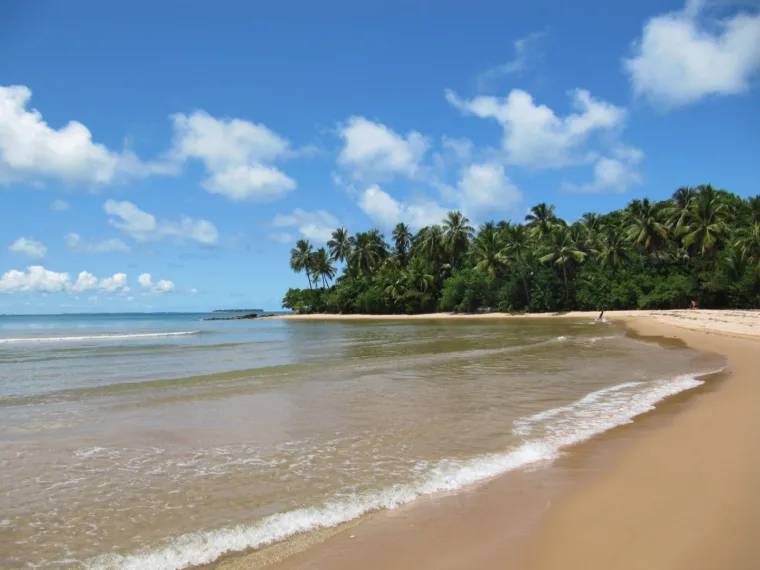

Madagascar: Easy Island Adventure
All the wildlife of Madagascar, none of the hard expedition.
From £1,995
£399 deposit to reserve, payment plans available

Eleven days on one of Africa's last wild frontiers: snorkelling with whale sharks and giant manta rays off Tofo Beach, then inland to Zinave National Park, one of the continent's most ambitious rewilding projects.
Most people dream of swimming with whale sharks. Others dream of watching Africa's wildlife move freely across a landscape with no fences in sight and no other vehicle for miles. On this expedition you do both, in a country that most of the world has not caught up with yet.
Mozambique's coastline runs for more than 2,500 kilometres along the Indian Ocean, and the warm, plankton rich water off Tofo Beach draws in the largest fish on earth. Whale sharks cruise these shallows year round, giant manta rays queue at cleaning stations on the offshore reefs, dolphins run the surf line and turtles surface beside the boat. We spend the first half of the trip on the water, going out in small boats, reading the sea, and slipping in alongside animals that are entirely indifferent to us.
Then we leave the ocean behind and drive inland to Zinave National Park, where one of the most remarkable conservation stories in Africa is unfolding. A park emptied of wildlife by decades of war is being deliberately restocked, animal by animal, and elephant, buffalo, giraffe, zebra and antelope now move through mopane and sand forest that almost no international visitor ever sees. No queues of vehicles. No radio chatter. Just wilderness, and the sense that you are somewhere before it becomes somewhere.
Ten guests, one expedition leader, eleven days. This is not a resort holiday and it is not a crowded safari. This is Wild Mozambique.
You arrive into Maputo, connect on the short domestic hop north to Inhambane, and step out into heat, bougainvillea and the smell of the sea. Your leader will be waiting. The road to Tofo runs east through coconut palms and roadside markets for about forty minutes, and then the land simply stops and there is nothing but a long arc of white sand and the Indian Ocean.
There is time to check in, get out of your travelling clothes, swim if the light holds and walk barefoot on the beach in front of the lodge. Tofo is a small, ramshackle, cheerful place: fishing boats hauled up on the sand, a handful of bars, dogs asleep in the road and dive shops that have been here for decades because of what swims past.
We gather in the evening for the welcome dinner and the expedition briefing: how the next eleven days work, how the boat launches operate, what to expect in the water, the whale shark and manta code of conduct, and the honest version of what is and is not guaranteed at sea. Then an early night, because the ocean is best in the morning.
Breakfast early, then down to the beach where the boat is waiting on the sand. Tofo has no harbour, so launches are done the old way: everyone aboard, hold on, and the skipper picks his moment and drives straight out through the breaking surf. It is noisy, wet and completely exhilarating, and by the third day you will be doing it without thinking.
Once we are through, the day slows right down. Ocean safaris here are a patient business. We run the coast with the crew standing and reading the water, watching for the tell tale shadow and the slow dorsal fin of a whale shark, the dark diamond of a manta, or the splash of a bait ball with everything feeding on it. Along the way we will almost certainly find bottlenose and humpback dolphins, which often come to the bow, and there is a good chance of turtles and rays.
When we find something, we go in quietly and a few at a time. Your leader will be in the water with you every entry. Today is also when everyone gets properly comfortable: mask clearing, breathing, fin use, and the discipline of staying calm when something enormous arrives. Back on the sand by early afternoon, salt crusted and grinning.
Tofo's reputation was built on mantas. A few kilometres offshore, a series of rocky reefs rise off the sand bottom, and on top of them are cleaning stations: patches of reef where cleaner wrasse gather and where manta rays come in, hang almost motionless in the current and let themselves be worked over. Reef mantas here have wingspans of three metres and more, and the sight of one turning slowly beneath you, mouth open, is one of those things people go quiet about afterwards.
We spend the morning on the reef sites, snorkelling in clear water over coral, with potato bass, kingfish, moray eels, honeycomb rays and clouds of reef fish. Mantas are wild and not on a timetable, so we work with the crew's knowledge of where they have been that week, and we stay flexible: if a whale shark is reported on the way out, we go to the whale shark.
In the afternoon there is time to swim off the beach, sleep in the shade or walk into Tofo village, where the market sells everything from cashews and coconuts to fabric and fish landed that morning.
Today we give the sea a proper run at it. A longer day on the water lets us range further along the coast, work the current lines and bait balls, and go back for a second and third attempt if the first search comes up empty. Whale sharks are here year round off Tofo, but they are wild animals moving through a huge amount of water, and time on the ocean is the single thing that most improves your odds.
Standing beside a whale shark is difficult to prepare anyone for. They grow to more than twelve metres, they are patterned like a night sky, and they move with a slow, unhurried tail beat that you cannot keep up with for long even in fins. They feed on plankton, they have no interest in you whatsoever, and they pose no threat at all. Most people come out of the water talking nonsense for a while.
We break for lunch on the boat or back on the sand depending on conditions, and we keep the day flexible. If the ocean is generous we stay out. If it is not, we come in early, and try again tomorrow. That is the honest bargain of a wildlife expedition, and it is why we build in this much water time.
After three days of early starts and salt water, today is intentionally slow. Breakfast overlooking the sea, and then the day is yours.
Swim, sleep in the shade, read, walk the long beach north towards Barra, or wander into Tofo village with your leader. There is an optional extra ocean safari for anyone who cannot leave the water alone, and it is usually well subscribed. There is also the option of a dhow trip on Inhambane Bay, sailing on the same wooden boats that have worked this coast for centuries, or a short trip across the water into Inhambane town itself, a faded, handsome old Portuguese trading port with a cathedral, a market and a good deal of history.
In the late afternoon the fishing boats come in and the whole village turns out to meet them, hauling in the nets by hand while the light goes gold over the dunes. These quiet days have a habit of being the ones people talk about afterwards.
We leave Tofo early, with the sea still flat and the village barely awake, and turn inland. This is a proper African travelling day and it is worth treating as part of the adventure rather than a chore. The tarmac takes us north along the coastal highway, past cashew stalls, roadside barbers, churches, football games and children who will wave at the vehicle for a full minute, and then we turn west and the tarmac gives out.
The road into the interior runs through miombo and mopane woodland, sand tracks, thatched villages and enormous baobabs standing alone in cleared ground. There are no towns of any size out here and very little traffic. We stop for lunch, we stop when something is worth stopping for, and we watch the country change from coconut palm to dry bush.
By late afternoon we reach Zinave National Park, roughly four thousand square kilometres of restored wilderness on the Save River, and check into the lodge as the light goes. Dinner outside, the sound of the bush starting up, and quite possibly the best night's sleep of the trip.
Coffee before dawn, and out in the open vehicle as the sky turns. This is the best hour in the bush anywhere, and in Zinave it comes with the additional strangeness of knowing that you are almost certainly the only tourists in four thousand square kilometres.
We drive slowly through mopane woodland, sand forest and open floodplain, and what you see is the result of one of the most ambitious wildlife translocation programmes ever attempted in Africa. Thousands of animals have been moved into this park over the past decade, and the population is now breeding and spreading. Elephant, buffalo, giraffe, zebra, waterbuck, kudu, sable, nyala, impala and warthog are all here, along with more than three hundred bird species. The animals are not habituated in the way that Kruger's are, so sightings feel earned rather than served.
The middle of the day is too hot for the wildlife and for you, so we come back to the lodge for lunch and a slow few hours. We go out again in the late afternoon, and stop somewhere with a view for a drink as the sun goes down, which is the correct way to end a day in the bush.
Today we go further. A full day in the park with a packed lunch lets us reach areas that a two hour drive never gets to: the Save River frontage on the northern boundary, the sand forest, the open pans where game concentrates, and the quiet corners where the guides know something is likely.
The story of Zinave is worth understanding, and it is part of what makes this trip different from a conventional safari. Decades of civil war left this park almost empty of large mammals. Since the mid 2010s an enormous restoration effort has been under way, moving thousands of animals in from elsewhere in southern Africa, rebuilding a sanctuary area, employing and training local people, and slowly returning a functioning ecosystem to a landscape that had been stripped of one. Where possible we spend time with the people doing it, and hear it from them rather than from a brochure.
Wherever conditions allow, we get out of the vehicle for a guided walk with an armed ranger. Walking in the bush changes everything: you notice the tracks, the dung, the alarm calls, the size of things. It is the most immersive hour of the safari and it is entirely at the guide's discretion on the day.
One final game drive at first light, which is often the best one: the group has its eye in by now, everybody knows how to sit still, and the guides have been saving something. Breakfast back at the lodge, bags into the vehicles, and then we retrace the sand roads east.
It is a long day, but a different one from the drive out. You know the country now, you know the group, and there is a particular satisfaction in watching the mopane give way to palm trees and knowing that the sea is at the end of it. We stop for lunch on the way and get into Tofo in the late afternoon.
The first thing almost everybody does is walk straight down to the water. After three days of dust and dry heat, the Indian Ocean is a considerable pleasure.
One more time through the surf. The last ocean safari of the expedition is usually the loosest and the best: nobody needs telling how to do anything, the boat crew know exactly who wants what, and the whole group has stopped worrying about their mask and started actually looking.
We give it the morning, out along the same coast, hoping for a last whale shark, a manta, a turtle or a pod of dolphins in the surf line. Whatever the sea gives us, it is a good way to end.
The afternoon is free: swim, sleep, walk the beach one final time, or go into the village for a last look and a few things to take home. In the evening we gather for the farewell dinner overlooking the ocean, with fresh seafood, cold drinks and the traditional swapping of photographs and phone numbers. Somebody always says they thought this trip would be one thing and it turned out to be another, and they are usually right.
Breakfast together, a final look at the ocean, and then the short transfer back along the palm road to Inhambane airport for the flight to Maputo and onward international connections. Your leader will have confirmed everyone's timings the night before and will see the group through check in.
You fly home with sand in everything, a phone full of photographs and a set of stories that most people will not quite believe. A fish the length of a bus, three feet from your mask. A manta turning slowly overhead. An elephant in a park that had almost none a decade ago. A sand road going west with nothing on it.
Mostly you leave with the feeling that Africa still has genuinely wild corners left, and that you have just spent eleven days in one of them.
It is graded Medium, the second of our four grades. That is 11 days of it, so being ready matters more than being fast. If you are unsure whether it suits you, talk to us before you book rather than after: we would far rather move you to the right adventure than watch you struggle on the wrong one.
Every trip runs with qualified leaders, a risk assessment written for the route, emergency procedures and communications planned before departure, and local support on the ground. Travel insurance covering your chosen activities is a condition of booking.
Mozambique's entry rules have changed more than once in recent years and now depend heavily on your nationality, so please check the current requirement for your own passport well before you travel rather than relying on second hand information. Some nationalities can enter for tourism without arranging anything in advance, others need a visa obtained before departure, and the position can change at short notice. We will send you the current guidance and, where a visa or pre approval is required, the process to follow. Your passport must have at least six months' validity beyond your return date and two or more blank pages. Add your passport details to your guest portal early, particularly if you hold a passport other than a British one, so we can check the position properly for you.
Comprehensive travel insurance is a condition of joining this expedition and we will ask to see it. Your policy must cover medical treatment, emergency evacuation and repatriation, and it must cover snorkelling and travel in remote areas. Evacuation cover is the part that genuinely matters here: Zinave National Park is several hours by road from the nearest significant medical facility and serious cases mean an air evacuation to Maputo or South Africa. If you intend to add scuba diving locally, check that your policy covers it to the depth you plan. Please upload your policy number and your insurer's 24 hour emergency number to your guest portal by four weeks before departure, and we carry those details with us throughout.
See a travel clinic at least eight weeks before departure. Mozambique is a high risk malaria country with year round transmission on the coast and inland, and antimalarial medication is essential on this trip rather than optional. Take it exactly as prescribed, including the doses before and after travel, and use repellent and cover up at dusk, which is when the mosquitoes that carry malaria bite. Clinics commonly advise hepatitis A, typhoid and tetanus, and will discuss rabies for a remote itinerary. A yellow fever certificate is required if you are arriving from or transiting a country with risk of transmission, so check your routing. If you develop a fever at any point in the year after you return, tell your doctor you have been to Mozambique.
International flights are not included. We start and finish in Mozambique, and the usual routing is an international flight to Maputo (MPM) followed by the short domestic hop north to Inhambane (INH). There are no direct flights from the UK. Common routings to Maputo are via Johannesburg, Addis Ababa, Nairobi, Doha or Istanbul, and a Johannesburg connection is often the simplest. Please talk to us before booking the domestic leg, since we can normally put you on the same flight as the rest of the group, and add your international flight details to your guest portal as soon as they are booked. Domestic aircraft are small with tight baggage allowances, which is another reason to pack light.
November on this coast is hot, humid and beautiful, sitting at the start of the wet season. Expect daytime temperatures around 29 to 33 degrees Celsius on the coast, with warm nights and high humidity, and similar or hotter inland at Zinave, where the pre dawn game drives are the only genuinely cool part of the day. Rain, when it comes, is usually a heavy afternoon or evening downpour rather than all day drizzle, and it passes. Sea temperatures are around 26 to 28 degrees, so no wetsuit is needed, although a rash vest is strongly recommended for sun protection. The heat, not the cold or the rain, is what you plan for on this trip.
Mozambique's currency is the metical. Cards work in Maputo and at some larger lodges but are unreliable elsewhere, and cash machines are limited outside the cities, so plan to travel with cash and change some on arrival. South African rand and US dollars are accepted in some tourist businesses, but meticais are far better for anything local. Bring plenty of small denominations for market stalls, drinks and tips. Tips for boat crews, guides, drivers, rangers and lodge staff are not included and are genuinely appreciated in a country where tourism income goes a long way; your leader will advise on sensible amounts and will usually organise the crew tips as a group so nobody is put on the spot.
Whale sharks and manta rays are wild animals and no responsible operator guarantees them. What we can tell you is that the water off Tofo is one of the most reliable places in the world for both, that whale sharks are present here year round rather than in a narrow season, and that we build in multiple ocean safaris precisely so that one flat day does not decide your trip. We follow the code of conduct strictly: snorkelling only, small numbers in the water at a time, no touching, no chasing, no flash photography, no blocking the animal's path and no diving down onto it. That makes for a better encounter as well as a defensible one, and the research projects based in Tofo will happily take your photographs for identification.
You do not need to be a diver and you do not need to be a strong swimmer. All snorkelling is done from a boat in warm water with short swims, buoyancy aids are available to anyone who wants one, and your leader will spend the first morning getting everyone comfortable. What we do ask is honesty: add a note to your guest portal about how confident you are in open water when you book, so we can plan properly. One thing to know in advance is the launch. Tofo has no harbour, so boats are pushed off the beach and driven out through the breaking surf. It is bumpy, wet and briefly quite exciting, and by the second day everyone loves it, but it is worth knowing about rather than discovering.
Zinave is not Kruger and that is the point. It is a vast, remote park in the middle of an ambitious restoration programme, where thousands of animals have been reintroduced over the past decade and populations are still building. You can expect elephant, buffalo, giraffe, zebra, waterbuck, kudu, sable, nyala, impala, warthog and excellent birdlife, in a landscape you will almost certainly have entirely to yourself. Predators are present but this is not a park where big cat sightings are common, and anyone who arrives ticking off a list will be disappointed. Come instead for wilderness without an audience, for animals that behave like wild animals, and for the story of how a park emptied by war is being brought back.
Accommodation on this trip is comfortable and honest rather than luxurious, and the standard varies between the two legs. At Tofo we use a beachfront lodge with en suite rooms, a swimming pool, fans and mosquito nets, a couple of minutes from the sand. At Zinave we stay at a remote safari lodge with en suite rooms and full board, where power comes from solar or a generator and may run to a schedule, wifi is limited or absent, and there are no shops of any kind. Rooms are twin share as standard and a single supplement is available on request. Bring a head torch, a power bank and everything you expect to need, because nothing can be bought once we head inland.
Mozambican food is one of the pleasures of this trip. The coast delivers superb seafood, prawns, calamari, line caught fish and the country's famous piri piri, alongside coconut, cassava, rice and the Portuguese influence in the bread and pastries. Inland the cooking is simpler and hearty, and lodges cater well for a small group. Vegetarians can be looked after but the range on the safari leg is narrower, so bring a few of your own snacks. Vegan, gluten free and serious allergy requirements must be added to your guest portal when you book so that we can brief the lodges and boat crews in advance, and please understand that in remote locations the options may be repetitive.
Mobile coverage is good in Maputo and Inhambane, reasonable at Tofo and effectively non existent for much of the inland leg and in Zinave. Local SIM cards are cheap and easy in Maputo or Inhambane and your leader will help you get one; international roaming is expensive and patchy. Wifi at the coast ranges from usable to decorative and should not be relied on at the park. Power is 220 volts, using a mixture of South African three round pin and European two pin sockets, so bring a universal adaptor and a power bank. For photography, bring a zoom lens for the safari and a waterproof housing, pouch or action camera for the water, plus more memory and battery than you think you need.
This expedition is built around two conservation stories. Tofo's marine life supports a long established research community studying whale sharks and manta rays, and we work with operators who follow the code of conduct, keep group numbers small and contribute their sightings; your photographs can be submitted to the identification databases and genuinely help. Inland, your park fees go directly into the restoration of Zinave, a landscape emptied of wildlife by decades of conflict and now being rebuilt animal by animal, with local employment and training at its centre. We do not use single use plastic bottles, we buy locally where we can, and we ask guests to buy from local businesses rather than haggling hard over very small sums.
This expedition takes a maximum of ten guests and is led throughout by Joe Alexander. It suits wildlife enthusiasts, photographers, adventurous couples, solo travellers and anyone who wants a genuine trip rather than a resort holiday. Solo travellers are extremely welcome and make up a good share of most departures; rooms are twin share as standard, we will pair you with someone of the same sex, and a single supplement is available if you would rather not share. You do not need to be a diver or an athlete. You need reasonable general fitness, tolerance for heat, long road days and simple facilities in places, and the sort of temperament that treats an unexpected change of plan as part of the story.
Secure your place with a deposit today, then spread the balance interest free. How payment plans work
Not sure yet?
Talk it through with someone who has been there. Call 0191 903 9936 or send us a question.
| Dates | Availability | Price | Book |
|---|---|---|---|
| 12 - 22 November 2028 | Places available10 places left | £4,995 | Book this date |
All the wildlife of Madagascar, none of the hard expedition.
From £1,995
£399 deposit to reserve, payment plans available
Ancient rock art in Somaliland, then swim with whale sharks in Djibouti.
From £3,750
£750 deposit to reserve, payment plans available
Snorkel with whale sharks, release turtle hatchlings, sleep in a beach camp.
From £1,995
£399 deposit to reserve, payment plans available